
Why We Invested in SatVu
The Last Major Remote Sensing Modality Is Finally Going Commercial
By: Ryan Clinton
You can camouflage a facility. You can operate at night. You can paint a roof to blend into satellite imagery. What you cannot do is hide the heat. Every active industrial asset on earth, factories, power plants, refineries, military installations, data centers, radiates thermal energy around the clock. And until recently, no commercial satellite could see it at a resolution that actually mattered.
Satellite imagery has become a mature commercial market. Optical providers like Planet and Maxar sell high-resolution photos of the earth’s surface. Synthetic aperture radar (SAR) companies like ICEYE and Capella image through clouds and darkness. Both modalities have attracted billions in venture capital and built real businesses. But infrared, the part of the electromagnetic spectrum that reveals heat and by extension activity, has been stuck. Legacy government satellites measure thermal data at resolutions of hundreds of meters. That’s useful for weather forecasting. It’s useless for telling you whether a specific power plant is running.
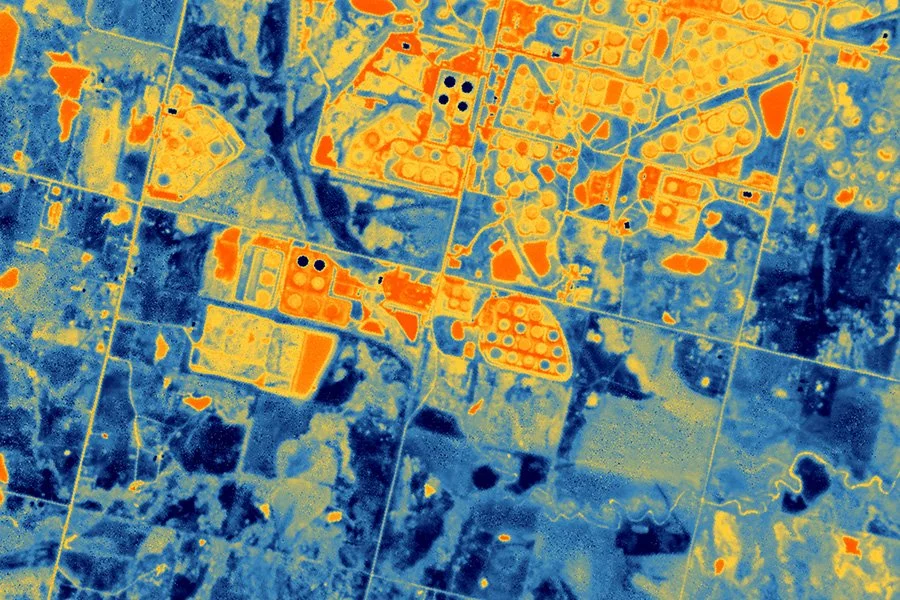
SatVu is building the first commercial constellation of high-resolution thermal imaging satellites. Their mid-wave infrared (MWIR) sensors image at 3.5-meter resolution, roughly 20x better than the nearest commercial competitor in the thermal band. At that resolution, thermal stops being a blunt instrument and becomes a precision intelligence product.
Why Thermal Matters
The simplest way to think about it: optical imagery shows you what things look like. Thermal imagery shows you what things are doing.
A refinery that appears identical in an optical image on two different days might be running at full capacity on one and shut down on the other. Thermal data makes that distinction immediately obvious. The same logic applies across sectors. Defense and intelligence agencies can detect operational activity at denied facilities, day or night, regardless of camouflage or concealment. Energy companies can identify which grid assets are active and which are degrading. Commodity traders can assess production levels at smelters and processing facilities weeks before official reporting.
These are use cases that customers were willing to pay for before SatVu had a satellite in orbit. The company built a pipeline of over 130 organizations across defense, energy, finance, and climate before its first launch. That kind of pre-launch demand is unusual in space, and it told us something important about the market.
The Structural Advantage
When we first looked at SatVu in early 2021, the infrared segment was the most underdeveloped category in the entire smallsat ecosystem with the fewest companies, the least VC funding, and the widest gap between government demand and commercial supply. That asymmetry was the starting point for our thesis.
But the investment case went beyond market timing. SatVu’s architecture was distinctive in a way that reduced the risks that typically kill space startups.
Rather than designing and building satellites in-house, SatVu partnered with SSTL, an Airbus subsidiary and the global leader in small satellite manufacturing, for the hardware. SSTL gave SatVu exclusive commercial rights to the best MWIR sensor available for smallsats, built by Leonardo. That partnership retired most of the manufacturing and launch risk that consumes other space startups' capital and attention.
This matters structurally beyond just risk management. The cost of capital for early-stage companies is high. Startups that take on low-margin, capital-intensive activity in-house, like satellite manufacturing, tie up resources that compound far more effectively in software, data products, and go-to-market. By outsourcing hardware to a best-in-class partner, SatVu concentrated its spend on the parts of the stack where margins are highest and IP builds over time. The result is a company that looks more like a data analytics business than a satellite manufacturer. That's a meaningful distinction when you're underwriting commercial outcomes.
The Team
CEO Anthony Baker spent two decades operating and scaling billion-dollar satellite businesses including AsiaSat, New Skies, and Es'hailSat. He brought an operator's pragmatism to a market that attracts plenty of ambitious engineers but not enough people who've actually built satellite businesses. VP of Business Development Simon Tucker brought 20 years in energy markets, one of SatVu's most important verticals.
Since the initial investment, the leadership team has continued to strengthen. Co-founder Tobias Reinicke now serves as Chief Information Officer, overseeing secure product delivery, platform integrity, and satellite operations as the company enters sustained multi-satellite operations. Scott Herman has joined as Chief Technology Officer, bringing more than 30 years building and operating space-based intelligence capabilities trusted by the national security community, with senior leadership roles at BlackSky, Maxar, and Cognitive Space. That combination of commercial operator experience, deep technical credibility, and national security pedigree is exactly the team profile required to win in this market.
The founding team's composition reflected a deliberate bet that this market would be won through product-market fit and go-to-market execution, not just sensor performance. That instinct has proven correct.
Dual-Use by Default
SatVu sits squarely in the category we care most about at Ridgeline: commercial technology with clear national security applications. The same thermal constellation that helps energy companies monitor grid infrastructure gives defense and intelligence agencies persistent, all-weather insight into adversary activity. The U.S. National Reconnaissance Office has added SatVu to its roster of commercial imagery vendors. The NATO Innovation Fund invested in the company's latest round. The UK's Copernicus program awarded SatVu its first Category 1 Contributing Mission contract.
None of that happened because SatVu was built for government. It happened because SatVu built a commercially compelling product that governments realized they needed. That's the dual-use pattern that actually works.
Where We Are Now
We've been with SatVu since the seed round in 2021 and have participated in nearly every subsequent raise. The company recently closed a £30M round led by Molten Ventures with participation from the NATO Innovation Fund and British Business Bank among others. Two satellites are slated for launch in 2026, with three more under contract.
As of this month, HotSat-2 is now in orbit and communicating. Following its launch aboard SpaceX Transporter-16, the satellite established contact within hours and is progressing through commissioning. That milestone matters beyond the technical achievement: it validates the architecture, retires the single-satellite risk that HotSat-1's anomaly created, and puts SatVu on a clear path to delivering persistent, multi-satellite thermal coverage. Once HotSat-2 reaches full operations, customers across national security, energy, and economic monitoring will have access to a genuinely new layer of operational intelligence from space, available day or night, regardless of cloud cover or concealment.
Our focus has been on opening doors into the U.S. federal market, connecting the team with defense and intelligence community stakeholders, advising on procurement pathways, and helping the company navigate the specific requirements of selling to government customers while scaling commercially.
Thermal infrared is the last major remote sensing modality to be commercialized at high resolution. The demand has been there for years. The technology is now ready. HotSat-2 is on orbit. SatVu is the company best positioned to own that transition, and we think the market is significantly larger than most people realize.